Vedic Wisdom
Chart Formats in Jyotish Astrology
Chart Formats in Jyotish Astrology
Summary: A comparison of the two primary birth-chart formats used in Jyotish Astrology—the North Indian and South Indian systems—along with suggested adaptations for students learning Jyotish. This overview is particularly useful for beginners seeking to understand and interpret Vedic astrology charts.
North Indian and South Indian Chart Formats Compared
Most Western astrologers use a circular horoscope format, but this style of chart is not commonly used in Jyotish.
In Vedic Astrology, there are two main chart formats: the North Indian system and the South Indian system. For newcomers to the subject, this can initially be confusing because the charts appear very different from one another. However, both formats display exactly the same astrological information—they simply present it in different ways.
The diamond-shaped grid is predominantly used in North India, while the rectangular grid is more commonly used in South India. Both charts shown in the illustration below contain identical astrological data.
In the North Indian format, the Ascendant is always placed in the upper diamond-shaped section, and the zodiac signs are often numbered from 1 to 12, corresponding to Aries through Pisces. In the example horoscope shown, the Ascendant is in Pisces, the 12th sign, with both Jupiter and Venus positioned in the Ascendant. Rahu is located in Cancer, the 4th sign, which corresponds to the 5th house in this particular chart, and so on.
Comparison between North and South Indian Jyotish Chart Formats
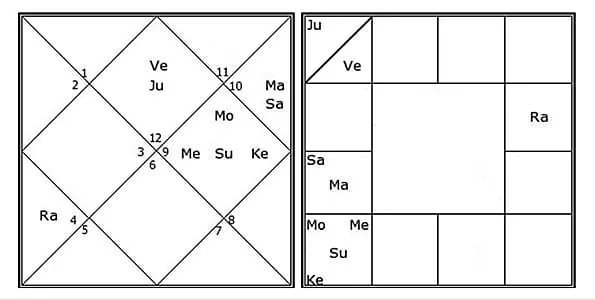
The zodiac signs used in Jyotish have the same names as those found in Western Astrology, such as Aries, Taurus, Gemini, and so forth. However, their actual positions in the sky differ from those used in Western astrology.
This difference arises because Vedic Astrology references the zodiac signs against the background of the fixed stars and therefore uses the Sidereal Zodiac, whereas Western Astrology generally uses the Tropical Zodiac.
At present, there is approximately a 24-degree difference between these two systems. The Tropical Zodiac takes the Spring Equinox as the zero-degree reference point for Aries, but this reference gradually shifts against the fixed stars due to the phenomenon known as the precession of the equinoxes.
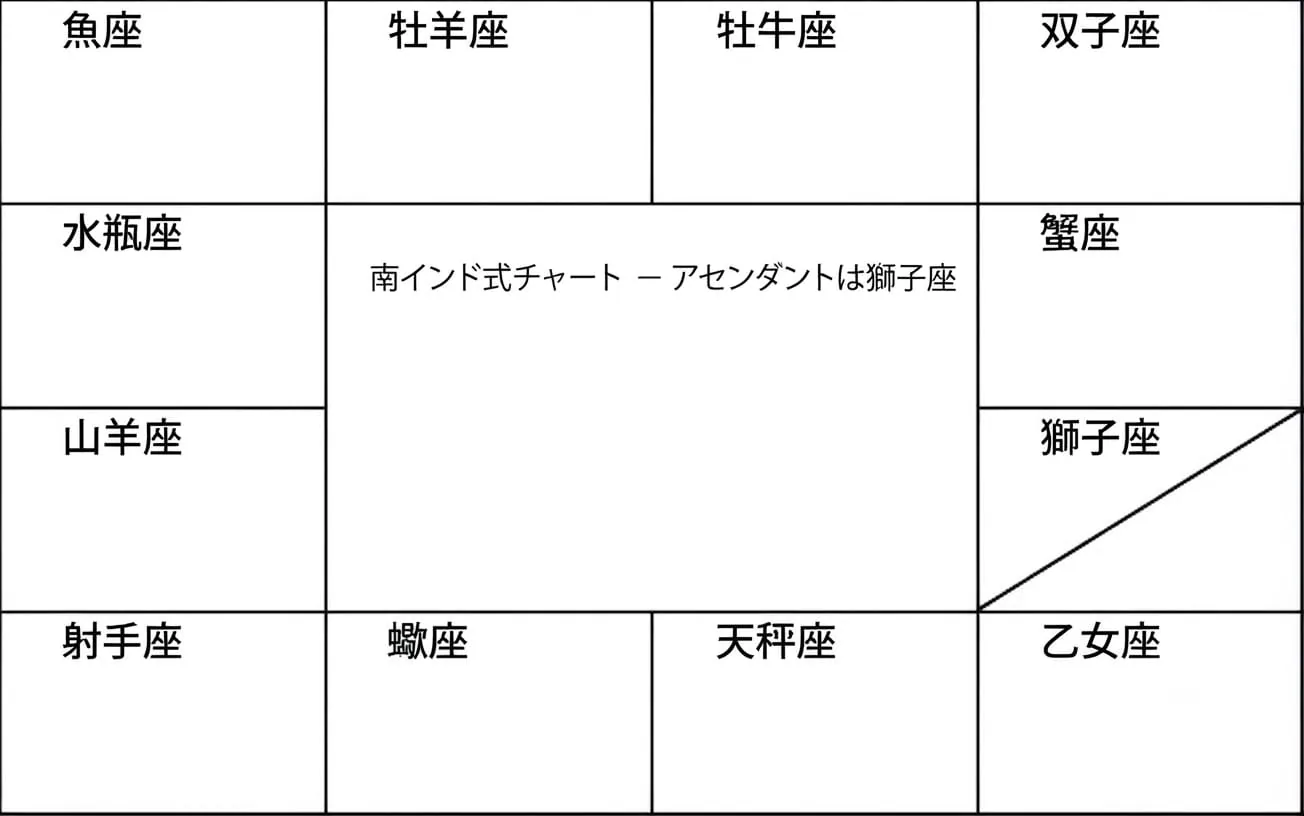
For those beginning their study of Jyotish, I believe a slightly modified version of the South Indian rectangular chart format is generally easier for Western students to understand and work with (see the diagram at the end of this article).
South Indian Jyotish Birth-chart Format
In the South Indian chart system, each zodiac sign always occupies the same fixed position within the chart. For example, Pisces remains in the upper-left box, while Virgo always occupies the lower-right box.
The zodiac signs are counted in a clockwise direction around the rectangular chart: Aries (1), Taurus (2), Gemini (3), Cancer (4), Leo (5), and so on.
The Ascendant is indicated by a single diagonal line placed within the relevant sign. This remains the same regardless of the exact Ascendant degree. For example, an Ascendant at 1° Leo and an Ascendant at 29° Leo are both represented identically.
In this system, houses correspond exactly to signs and are counted clockwise from the Ascendant. Thus, if the Ascendant is in Leo—whether at 1 degree or 29 degrees—the entire sign of Leo becomes the 1st house, the whole sign of Virgo becomes the 2nd house, Libra becomes the 3rd house, and so forth.
South Indian Vedic Astrology Chart Format
← Houses (Bhavas)