Vedic Wisdom
Jyotish – Sidereal Zodiac
Jyotish – Sidereal Zodiac
Summary: This article explores the differences between the zodiacs used in Vedic Astrology and Western Astrology. It explains why Jyotish relies on the fixed Sidereal Zodiac rather than the movable Tropical Zodiac. In doing so, it addresses one of the primary objections astronomers raise against astrology. The article also demonstrates how Sun signs, Ascendants, and all planetary positions can appear in different signs when calculated using the two systems.
Jyotish Uses the Fixed Sidereal Zodiac
Jyotish Astrology uses a different zodiac from the one employed in Western Astrology.
The zodiacs used by both Jyotish and Western Astrology are based upon an imaginary celestial sphere. In each system, this sphere is divided into twelve equal sections of 30 degrees each, much like the segments of an orange. Both systems also use the same zodiac sign names, such as Aries, Taurus, Gemini, and so forth. The Sun appears to move through each zodiac sign in approximately one month.

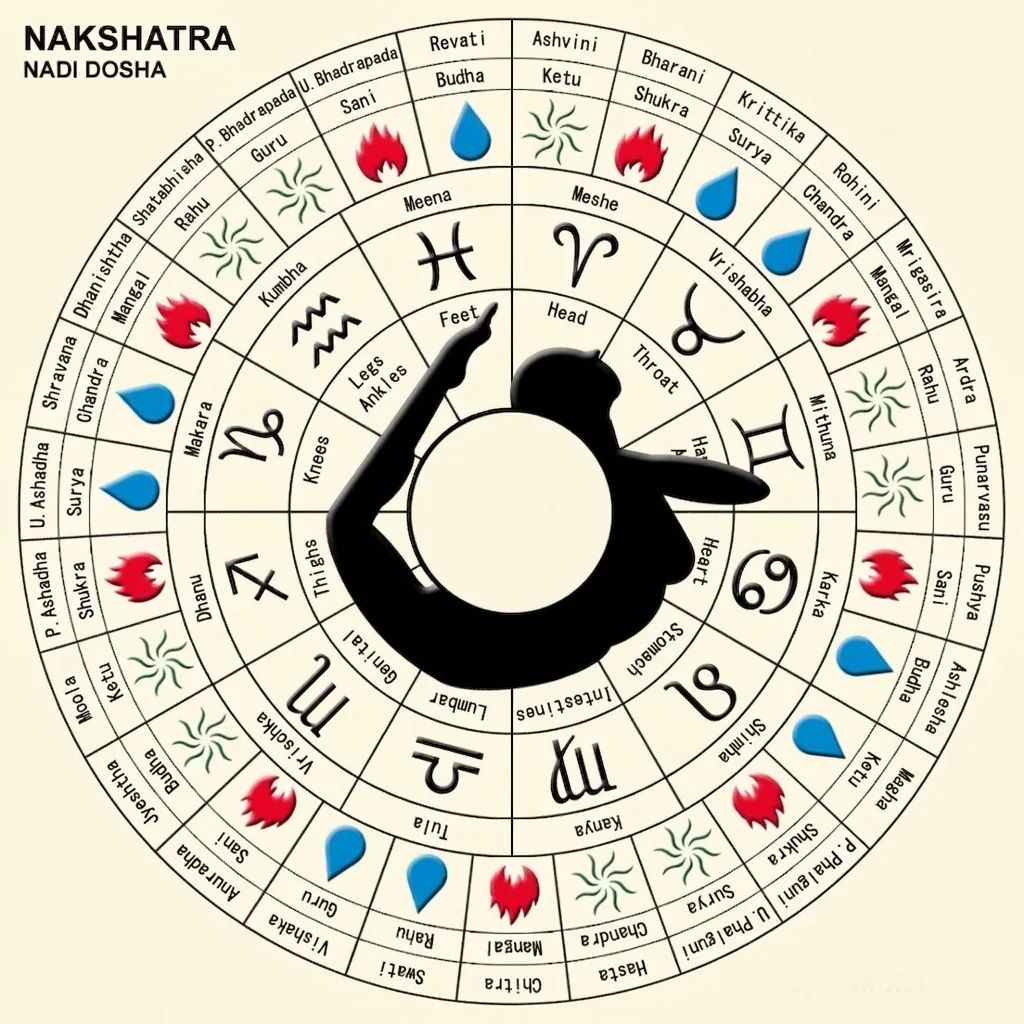
Jyotish uses the fixed Sidereal Zodiac. The term Sidereal means "with respect to the stars." The starting point of the Sidereal Zodiac is permanently anchored using the background of the fixed stars within our galaxy as its reference point.[1] As a result, the zodiac signs remain forever fixed relative to the stellar constellations.
Therefore, in Vedic Astrology, the beginning of the first sign, Aries, never changes position. Since Aries remains fixed, all of the remaining zodiac signs also stay permanently aligned with the distant background stars.
Western Astrology, by contrast, uses the movable Tropical Zodiac. The starting point of this zodiac gradually shifts relative to the background of the fixed stars because it is referenced to the equinox. This movement occurs due to the astronomical phenomenon known as the precession of the equinoxes.[2]
Consequently, in Western Astrology, the position associated with the sign Aries slowly moves through the sky against the background of the fixed stars. It is therefore not permanently linked to any specific stellar constellation. Many people—including students of Western Astrology—find this fact quite surprising.
Astronomers often criticize Western Astrology because it employs the movable Tropical Zodiac, meaning that the sign Aries changes its position relative to the stars over time. However, this criticism does not apply to Jyotish because Vedic Astrology uses a fixed zodiac rather than a moving one.
Ayanamsa – Angular Difference Between the Two Zodiacs
The angular difference between the Sidereal and Tropical zodiacs is known as the Ayanamsa (ayanāṃśa or ayanamsha), and this difference gradually increases over time.[3]
Although the starting points of the two zodiacs were approximately aligned around 1,700 years ago, the Tropical Zodiac used in Western Astrology has steadily moved away from that original position.
As of 2021, the difference between the two systems is approximately 24 degrees. This means that if the Sun is positioned at 29 degrees Virgo in the Tropical Zodiac, it will appear at approximately 5 degrees Virgo in the Sidereal Zodiac after subtracting the 24-degree Ayanamsa.
In this example, the Sun remains in Virgo in both systems.
However, if the Sun is located between 0 and 24 degrees Virgo in the Tropical Zodiac, it will move into Leo when calculated using the Sidereal Zodiac employed by Jyotish. In effect, the planet shifts backward (anti-clockwise) by the Ayanamsa value and enters the previous sign.[4]
As a result, a person's Sun sign may differ depending on which zodiac is used. For example, an individual classified as a Virgo in Western Astrology may become a Leo in Jyotish.
The same principle applies not only to the Sun but also to all other planets and to the Ascendant. These differences in planetary and Ascendant placements help explain many of the inconsistencies sometimes encountered in charts interpreted solely through the modern Western system.
Nakshatras – ‘Stellar Constellations’
Jyotish places considerable importance on the Nakshatras, or stellar constellations, when interpreting birth charts, assessing compatibility, and determining auspicious timing through Muhurta.
There are twenty-seven Nakshatras, sometimes referred to as Lunar Mansions, distributed evenly throughout the zodiac (more precisely, as equal divisions along the ecliptic).
Given the importance of the Nakshatras within Jyotish, it is hardly surprising that Vedic Astrology uses a zodiac that remains permanently aligned with both the fixed stars and the Nakshatra system.
Footnotes
[1] The so-called "fixed stars" are located at such immense distances from Earth that their angular movement relative to our Sun is extremely small, even across thousands of years. For practical purposes, they can therefore be regarded as fixed or immovable reference points.
[2] The equinox point on Earth's orbit around the Sun shifts relative to the background of the fixed stars because of the phenomenon known as the precession of the equinoxes. This occurs due to a slight wobble in Earth's rotational axis, similar to the motion of a spinning top whose axis slowly traces out a cone-shaped path. One complete precessional cycle takes approximately 26,000 years.
[3] As of 2021, the angular separation between the Tropical and Sidereal zodiacs is approximately 24 degrees. This value, derived by Lahiri, is widely accepted among Jyotish Astrologers, and most astrological tables use Lahiri Ayanamsa. The Tropical Zodiac moves relative to the Sidereal Zodiac by roughly one degree every 71 years. Although this annual shift is small, it accumulates significantly over long periods. Remarkably, ancient Egyptian astronomers observed this movement thousands of years ago.
[4] The current difference between the two zodiacs is approximately 24 degrees. For example, if the Sun is positioned at 14 degrees Virgo in Western Astrology, subtracting the Ayanamsa gives 14 – 24 = –10 degrees Virgo in the Sidereal system. Since this falls before the beginning of Virgo, the Sun effectively moves backward into Leo and occupies 20 degrees Leo (–10 + 30 = 20).
By contrast, if the Sun is at 28 degrees Virgo in the Tropical Zodiac, subtracting the Ayanamsa results in 4 degrees Virgo in the Sidereal Zodiac. In this case, the Sun has shifted backward but remains within the same sign.
← Introduction