Vedic Wisdom
Planetary Strengths or Powers
Planetary Strengths or Powers
Summary: This article covers one of the most important aspects of chart interpretation—assessing the "strength," "power," or "status" of a planet based on its sign placement in a birth chart. It also explains the principles of sign ownership (rulership), the concepts of planetary "friends" and "enemies," and examines how retrograde motion, combustion, Vargottama status, divisional charts, and planetary war influence planetary strength.
Sign ‘Ownership’ or ‘Rulership’ Principles
The Vedic seers assigned each sign of the zodiac to a particular planet.
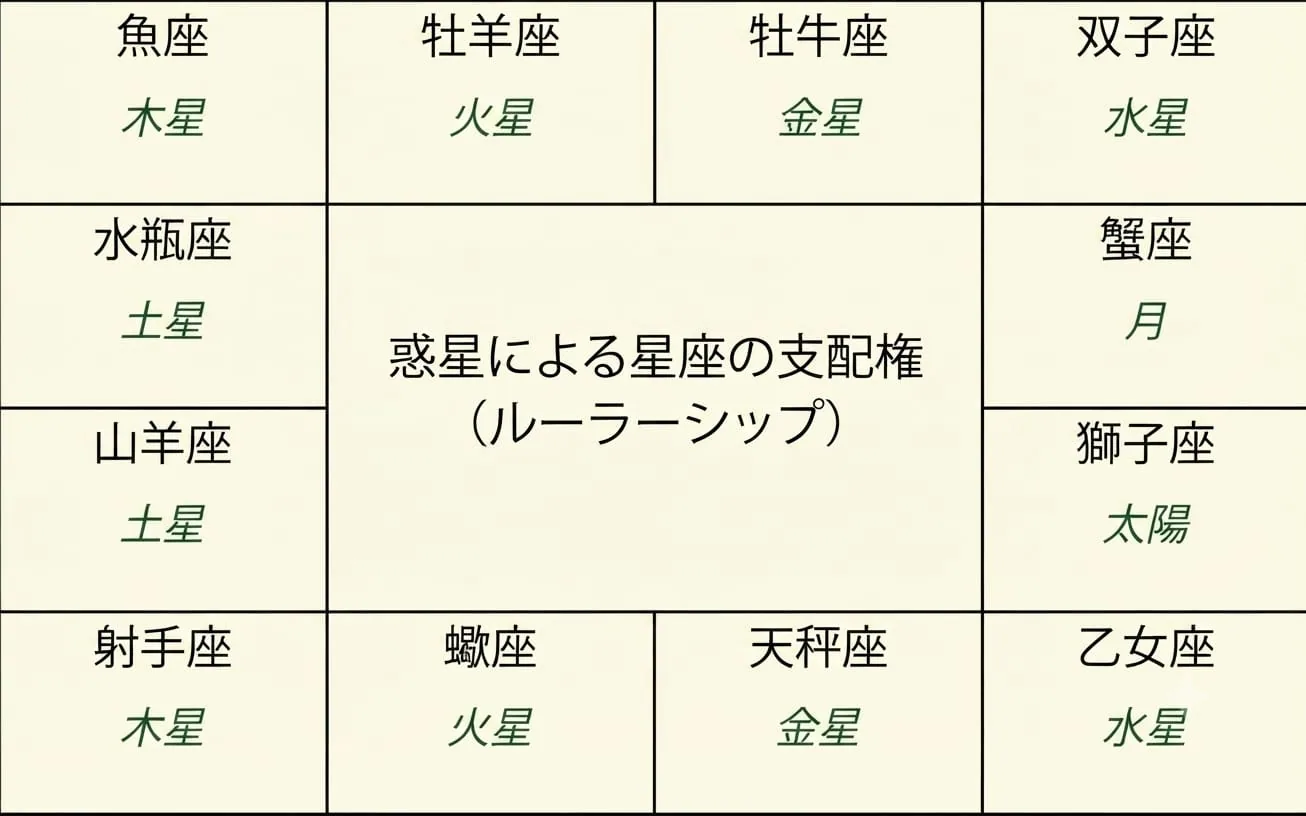
Sign Ownership or Rulership by Planets in Jyotish
For example, from the chart above we can see that the Sun is associated with the sign Leo. Therefore, the Sun is said to be the Owner or Ruler of Leo (sidereal).
Notice that the Sun and Moon each rule only one sign, whereas the remaining visible planets—Mars, Mercury, Jupiter, Venus, and Saturn—each rule two signs. Thus, Jupiter rules Sagittarius and Pisces, Mercury rules Gemini and Virgo, and so on.
It is important to note that Rahu and Ketu do not own or rule any zodiac sign.
Planetary ‘Strengths’ or ‘Powers’ – by Sign Placement
In Jyotish, evaluating the strength or power of a planet is a fundamental part of chart interpretation.
A planet regarded as strong tends to produce benefits and indicates positive returning karma. In general terms, a strong planet is usually considered a beneficial planet.
There are two primary ways in which a strong planet produces positive results:
1. Benefits Through the Planet’s Natural Indications
A strong planet supports the life areas represented by its natural associations or Karakas.
For example, the Sun naturally signifies health, vitality, self-esteem, authority, power, and the relationship with one's father. Therefore, when the Sun is strong in a chart, we generally expect positive outcomes in these areas.
Similarly, the Moon naturally represents the mind, emotions, memory, and mental well-being. A strong Moon would therefore support emotional balance, memory, and mental stability.
2. Benefits Through the Houses the Planet Rules
A strong planet also supports the houses associated with the signs that it owns or rules.
In Jyotish, each house encompasses an entire zodiac sign. Consequently, every house is connected to a particular sign and therefore to a ruling planet. When constructing a horoscope, the Ascendant sign becomes the first house.
For example, if a person has Aries rising, Aries becomes the first house. To examine matters relating to children, we look to the 5th house. Counting clockwise from Aries, Leo becomes the 5th house. Since the Sun rules Leo, a strong Sun would positively influence the affairs of the 5th house, including children, education, intelligence, and creativity.
This support would come in addition to the Sun's natural indications such as health, confidence, and authority.
To summarise, when a planet is strong, both its natural indications and the houses it rules receive support and benefit.
Assessing Planetary Strength from Sign Placement
Although planetary strength can be measured in numerous ways, one of the most important methods is by examining the zodiac sign in which the planet is placed.
In some cases, the specific degree within a sign can also affect the level of strength.
Vedic Astrology teaches that certain signs empower a planet and enable it to produce beneficial results, while other signs weaken it and may indicate challenges or more difficult returning karmas. Therefore, a planet's sign placement plays a major role in determining its strength.
When first learning astrology, a useful approach is to identify whether each planet falls into one of four principal categories of strength.
These are:
Exalted
Moolatrikona
Own Sign
Debilitated (or Fallen)
Exalted is the strongest condition, while Debilitated is the weakest. A planet placed in its Own Sign is generally considered strong and supportive.
The state known as Moolatrikona has no direct English equivalent but is regarded as stronger than Own Sign and slightly below Exaltation.
The sign of debilitation is always located exactly 180 degrees opposite the sign of exaltation.
For example, Venus is naturally benefic. When Venus occupies Pisces, its sign of exaltation, it can produce significant benefits through both its natural indications and the houses associated with Taurus and Libra, the signs it rules.
However, when Venus occupies Virgo, its sign of debilitation, its ability to provide positive results is greatly reduced.
A planet's capacity to produce beneficial outcomes therefore varies according to its strength, and its strength depends largely upon the sign in which it is placed.
The following sections provide the traditional strength classifications.
Planetary Strengths or Powers by Sign Placement
Sun (Surya)
Exalted Sign: Aries (maximum strength at 10° Aries)
Moolatrikona Sign: Leo 0°–20°
Own Sign: Leo 20°–30°
Debilitated Sign: Libra (maximum weakness at 10° Libra)
Moon (Chandra)
Exalted Sign: Taurus 0°–3°
Moolatrikona Sign: Taurus 3°–30°
Own Sign: Cancer
Debilitated Sign: Scorpio (maximum weakness at 3° Scorpio)
Mars (Mangala)
Exalted Sign: Capricorn (maximum strength at 28° Capricorn)
Moolatrikona Sign: Aries 0°–12°
Own Signs: Aries 12°–30° and Scorpio
Debilitated Sign: Cancer (maximum weakness at 28° Cancer)
Mercury (Buddha)
Exalted Sign: Virgo 0°–15° (maximum strength at 15° Virgo)
Moolatrikona Sign: Virgo 16°–20°
Own Signs: Virgo 20°–30° and Gemini
Debilitated Sign: Pisces (maximum weakness at 15° Pisces)
Jupiter (Guru)
Exalted Sign: Cancer (maximum strength at 5° Cancer)
Moolatrikona Sign: Sagittarius 0°–10°
Own Signs: Sagittarius 10°–30° and Pisces
Debilitated Sign: Capricorn (maximum weakness at 5° Capricorn)
Venus (Shukra)
Exalted Sign: Pisces (maximum strength at 27° Pisces)
Moolatrikona Sign: Libra 0°–15° and Taurus
Own Signs: Taurus 15°–30° and Libra
Debilitated Sign: Virgo (maximum weakness at 27° Virgo)
Saturn (Shani)
Exalted Sign: Libra (maximum strength at 20° Libra)
Moolatrikona Sign: Aquarius 0°–15°
Own Signs: Aquarius 15°–30° and Capricorn
Debilitated Sign: Aries (maximum weakness at 20° Aries)
Rahu
There is considerable variation among the ancient authorities regarding the signs where Rahu and Ketu are strongest or weakest. The following placements are based on the most reliable sources available.
Exalted Sign: Taurus
Debilitated Sign: Scorpio
Ketu
Exalted Sign: Scorpio
Debilitated Sign: Taurus
Additional Measures of Strength – ‘Friends’ and ‘Enemies’
Experienced astrologers use additional categories that lie between the states of Own Sign and Debilitation. These provide a more refined assessment of planetary condition.
Three important intermediate categories are:
Friend
Neutral
Enemy
A planet placed in a sign ruled by a friendly planet tends to function well, whereas a planet occupying the sign of an enemy is weakened.
Of course, planets do not literally have friends or enemies. These terms simply indicate that certain planetary environments are more supportive than others. For example, Venus is considered less comfortable and therefore less productive when placed in a sign ruled by an enemy such as the Sun.
In addition to these permanent friendship categories, Jyotish also recognises temporary friendships based upon the relative positions of planets within a chart. These create two additional classifications:
Great Friend
Great Enemy
Although charts and rules exist to determine these relationships, they can be challenging for beginners to memorise. Fortunately, most good Vedic Astrology software calculates these conditions automatically.
Together with the categories of Exalted, Moolatrikona, Own Sign, and Debilitated, these friendship classifications form the primary planetary states or Avasthas used in chart interpretation.
For a complete analysis, all nine categories should be considered. However, beginners can gain surprisingly accurate insights simply by focusing on the four major states: Exalted, Moolatrikona, Own Sign, and Debilitated.
The sage Parashara quantified the relative benefits of these states as follows:
Exalted: 100%
Moolatrikona: 75%
Own Sign: 50%
Friendly Sign: 25%
Neutral Sign: 12%
Fallen/Enemy Sign: 0%
These figures should not be interpreted too literally, but they provide a useful illustration of how planetary condition influences its ability to produce positive results.
The chart below summarises these relationships.
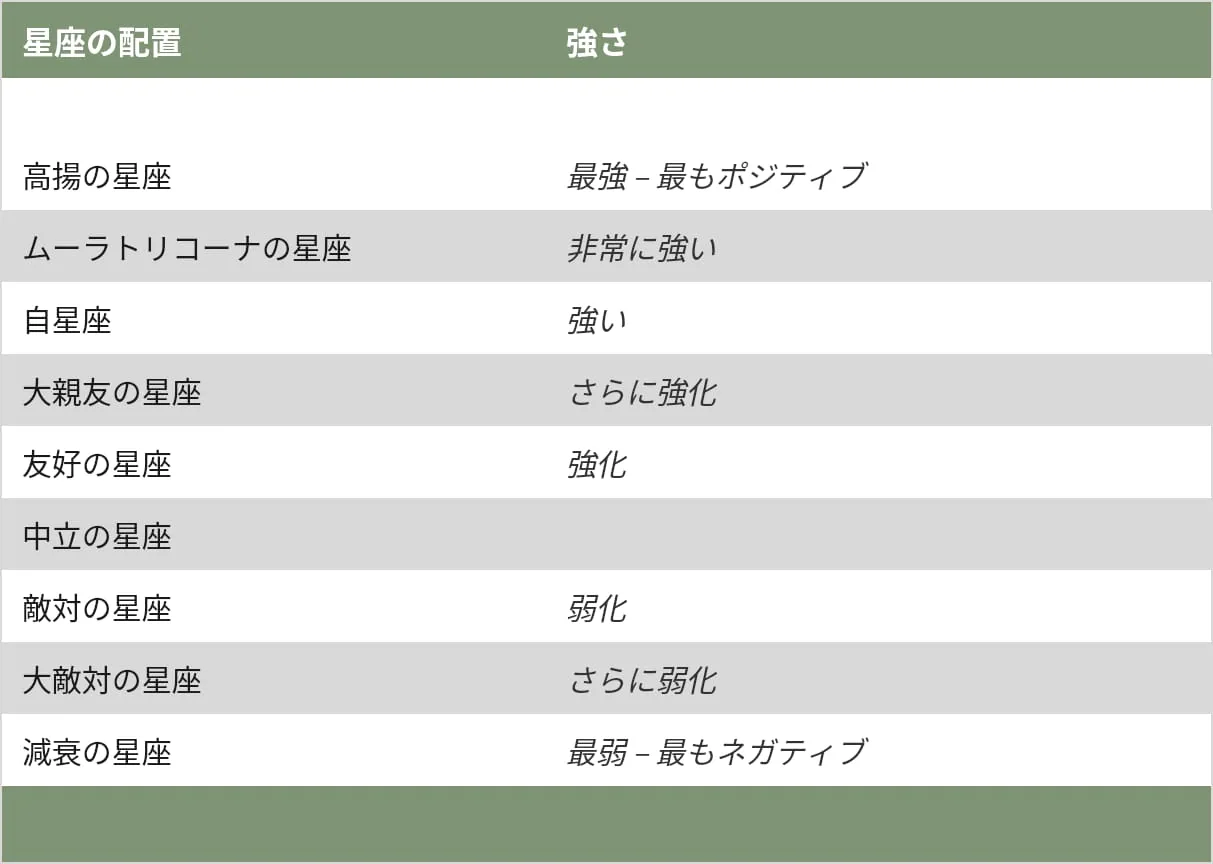
Please remember that the categories of Great Friend and Great Enemy depend upon temporary planetary relationships within a particular chart and are therefore not fixed.
Planetary Strengths by Sign Placement – Nine Categories or States in Jyotish
A table showing the relationship between sign placement (Exalted, Own Sign, etc.) and resulting planetary strength in Jyotish Astrology.
Other Factors Which Influence Planetary Strength
Several additional factors can modify planetary strength.
These include:
Retrograde motion
Combustion
Planetary War
Position in divisional charts
If you are completely new to Jyotish, you may wish to skip this section initially and return to it later.
Effects of Aspects on Planetary Strength
Planets receiving aspects from benefic planets such as Jupiter, Venus, Mercury, and the Moon gain strength. Consequently, both their natural indications and the houses they rule are enhanced.
Aspects in Jyotish are more sophisticated than those used in Western Astrology.
Planets receiving aspects from malefics such as Mars and Saturn become weakened. As a result, their indications and the houses they govern may experience challenges.
Note: Rahu and Ketu do not cast aspects.
Effect of Combust Planets in Vedic Astrology
When a planet comes too close to the Sun, it can become combust, meaning its ability to produce positive results is reduced.
This negatively affects both its natural indications and the houses it rules.
Mercury frequently becomes combust because it always remains relatively close to the Sun. Venus also commonly experiences combustion. When Venus appears as the Morning Star before sunrise, it is necessarily positioned fairly close to the Sun.
Generally, combustion occurs when a planet is within approximately 10 to 15 degrees of the Sun. However, the precise range varies according to the planet involved and whether it is moving direct or retrograde.
Rahu and Ketu never become combust.
Therefore, whenever a planet lies very close to the Sun, combustion should be investigated further.
Effect of Retrograde Planets in Jyotish
Another important factor influencing planetary status is retrograde motion.
No physical planet actually reverses its orbit around the Sun. However, due to the relative motions of Earth and the planets, they may appear to move backwards against the background of the fixed stars and constellations. This apparent reversal is known as retrograde motion.
Although astrologers differ somewhat in their interpretations, the general consensus is that retrograde planets gain strength. Since strength is usually regarded as beneficial in Jyotish, retrogression is often viewed positively.
This view is supported by the observation that retrograde planets generally need to move closer to the Sun before combustion occurs.
Planets with Vargottama Status
Vargottama is another factor that modifies planetary condition.
Beginners are often advised not to focus heavily on the divisional charts or Vargas. Nevertheless, the Navamsha chart (the ninth divisional chart) is especially important, not only for marriage and partnerships but also for assessing planetary strength.
A planet occupying the same sign in both the main birth chart and the Navamsha chart is said to be Vargottama.
This condition strengthens the planet considerably and is generally regarded as being at least equivalent to Own Sign status.
If a planet occupies its exaltation sign or own sign in both charts, its beneficial influence becomes even more powerful.
Planetary War in Jyotish
Planetary War occurs when two or more planets come into extremely close conjunction, usually within approximately one degree of each other.
Most Jyotish texts state that the planet at the lower degree wins the war, while the planet at the higher degree loses some of its ability to produce positive results.
There is little doubt that planets positioned this closely together create significant effects. However, there remains considerable scholarly debate regarding the exact conditions required for Planetary War and the precise outcomes experienced by the planets involved.
Note: The Sun, Moon, Rahu, and Ketu do not participate in Planetary War.
← Planets (Grahas)