Vedic Wisdom
Nakshatras – Stellar Constellations
Nakshatras – Stellar Constellations
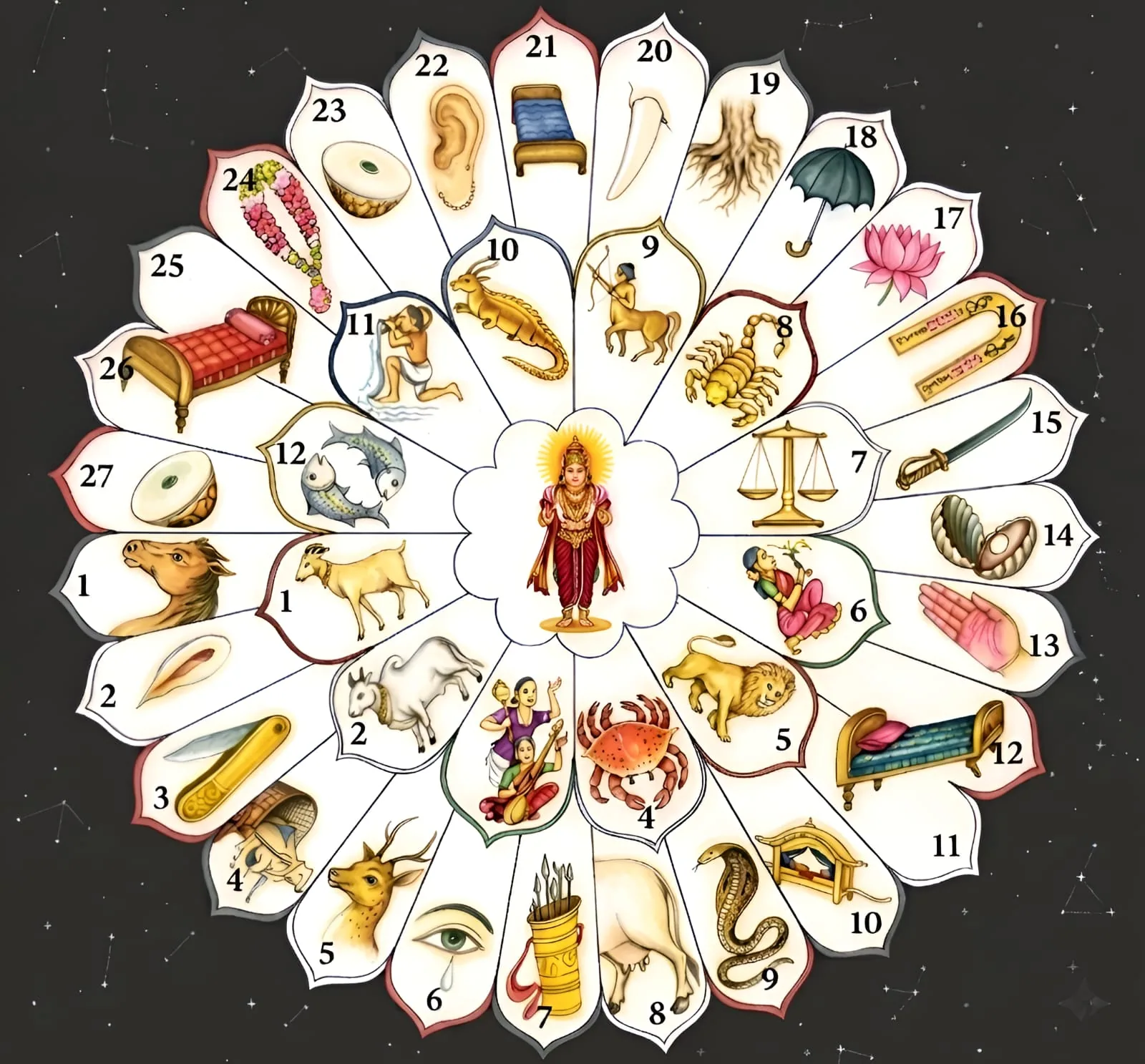
Jyotish places considerable importance on the stellar constellations known as Nakshatras. They play a vital role in chart interpretation, compatibility analysis, and determining favourable timings for important activities through Muhurtha.
There are 27 Nakshatras, often referred to as Lunar Mansions, distributed evenly throughout the sky. Technically speaking, they are arranged as equal sectors along the ecliptic.
Given the significance of the Nakshatras within Vedic Astrology, it is hardly surprising that Jyotish employs a zodiac system that remains permanently anchored to the fixed stars and therefore remains aligned with the Nakshatras themselves.
Footnotes
[1]
The "fixed stars" are located so far from Earth that their angular movement relative to our Sun is extremely small, even across many thousands of years. For practical purposes, it is therefore reasonable to describe them as fixed or immovable.
[2]
The equinox point on Earth's orbit around the Sun gradually shifts relative to the background of the fixed stars due to a phenomenon known as the precession of the equinoxes. This well-established astronomical effect results from a slight wobble in Earth's rotational axis, similar to the motion of a spinning top whose axis slowly traces out a cone-shaped path. Earth takes approximately 26,000 years to complete one full precessional cycle.
[3]
As of 2021, the angular difference between the Tropical and Sidereal zodiacs is approximately 24 degrees. This value, or one very close to it, was derived by Lahiri and is widely accepted among Jyotish astrologers. Most modern astrological tables therefore use Lahiri's ayanamsa.
The Tropical Zodiac moves relative to the Sidereal (fixed) Zodiac at a rate of approximately one degree every 71 years. Although this shift may appear small, it was observed by ancient Egyptian astronomers thousands of years ago. Over long periods, the accumulated effect becomes highly significant.
[4]
The difference in planetary positions between the two zodiac systems is currently about 24 degrees. For example, if the Sun is positioned at 14 degrees Virgo in Western Astrology, its Sidereal position would be calculated as:
14° – 24° = –10° Virgo
This indicates that the Sun is actually 10 degrees before the start of Virgo. In practical terms, it has moved backwards (anti-clockwise) into the previous sign, Leo, where its position becomes 20 degrees Leo (since –10 + 30 = 20).
By contrast, if the Sun is located at 28 degrees Virgo in the Tropical Zodiac, the calculation becomes:
28° – 24° = 4° Virgo
Although the Sun has still shifted backwards by the ayanamsa amount, it remains within Virgo and therefore does not change signs.
← Nakshatras