Vedic Wisdom
Jyotish – Origins of Vedic Astrology
Jyotish – Origins of Vedic Astrology
Summary: This article explores the origins of Vedic Astrology (Jyotish) and the process of Vedic cognition. It identifies the great Vedic Seer Maharishi Parashara as the ‘father of Jyotish Astrology’ and discusses his classical Jyotish text, the Brihat Parasara Hora Shastra.
Origins of Vedic Astrology and the Process of Vedic Cognition
Ask a Western Astrologer about the origins of astrology and they will usually provide a chronological account describing how the subject passed from one culture to another, moving between countries and civilizations over time. Western modes of thought are comfortable with this approach because it aligns with our sense of history. We enjoy organising the past through names, dates, timelines, and geographical locations.
Ask a Jyotish Astrologer the same question and the answer is likely to be that it “came from God” [1]. This is a crucial point and highlights a fundamental distinction between Jyotish and Western Astrology. According to Vedic tradition, the knowledge of Jyotish Astrology, just like the knowledge of maintaining perfect health through Ayurveda and the vast body of Vedic Science as a whole, was not invented but rather revealed or cognized.
Jyotish was neither discovered nor created by human beings, nor was it gradually developed through experimentation over centuries.
There are few clear equivalents within Western thought to explain the process of Vedic cognition. Perhaps the closest comparison would be moments of extraordinary artistic inspiration, creative genius, or scientific insight, where the complete understanding of a great work, invention, or theorem seems to appear in the mind instantly.
Modern ‘Download’ Analogy to Vedic Cognition Process
All of the great works of Vedic Science are said to have originated through revealed knowledge or cognition within the consciousness of highly evolved sages, seers, and Rishis of ancient times. These individuals devoted entire lifetimes to the practice of Yoga and meditation, enabling them to access higher states of awareness. Their level of consciousness was far beyond what most people experience in everyday life.
A useful modern analogy is the Internet. Imagine connecting a personal computer to a remote server—or even to “The Cloud”—and downloading all the information required directly into the machine. Naturally, we must know how to operate the computer correctly and possess the necessary password—perhaps comparable to using the correct Sanskrit mantras—to gain access to the information stored remotely. This analogy reflects the Vedic Model of Reality, in which the universe and all living beings are viewed as parts of an interconnected whole.
If we continue with this analogy, it becomes clear that the information stored on a server exists whether or not our computer, tablet, or phone can access it. The same principle applies to the knowledge of Vedic Astrology. The information within the “Cosmic Computer” is always present, waiting to be accessed. During certain ages, direct access to this knowledge may be available to a small number of enlightened individuals.
In the current Dark Age of Kali Yuga [2], direct cognition is considered unavailable. As a result, we rely upon the cognized wisdom passed down by enlightened sages from previous ages.
Maharishi Parashara – ‘Father’ of Vedic Astrology
The Vedic Sage, or Seer, most widely regarded as the “father of Jyotish Astrology” is Maharishi Parashara (Maha meaning “great” and Rishi meaning “seer”) [3]. His Sanskrit work, the Brihat Parasara Hora Shastra [4], remains one of the most important and influential texts in Vedic Astrology.
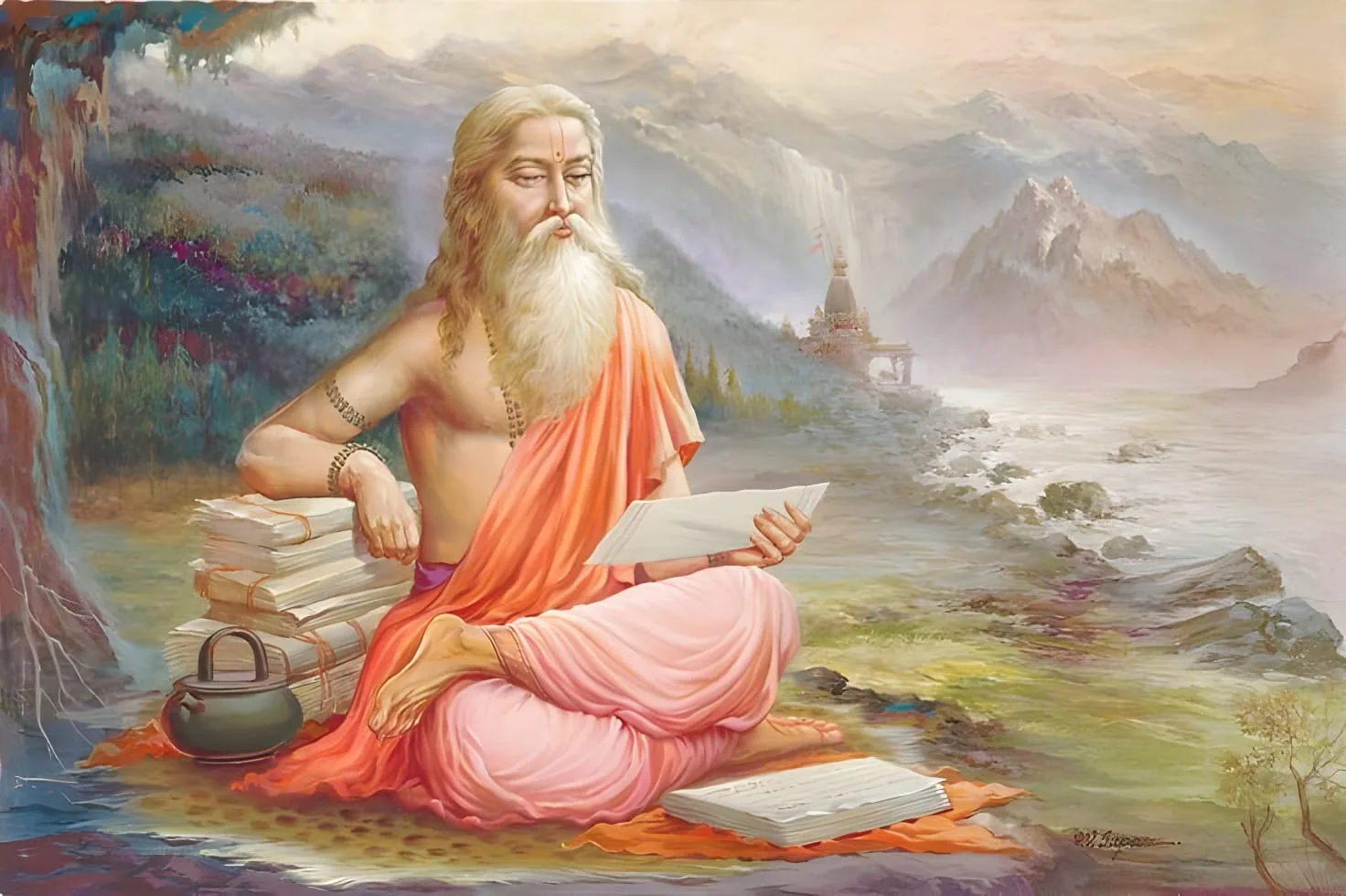
From the Vedic perspective, exactly when or where Parashara lived is of secondary importance. Even if his teachings had been lost over the course of time, it would not fundamentally matter because the knowledge was never considered to be personally his. The wisdom itself existed independently and was simply cognized through him. Future Rishis born in other ages could once again re-cognize the complete body of Jyotish Shastra and make it available for the benefit of humanity.
Footnotes
[1] The Vedic concept of God differs significantly from the idea of a distant, judgemental deity often associated with the Abrahamic traditions. In the Vedic understanding, the all-pervading “GOD” may be viewed as a three-letter acronym representing fundamental principles of nature: G – Generator (personified as Brahma), O – Operator (personified as Vishnu), and D – Destroyer (personified as Maheshwara or Shiva). This divine reality is not something separate from us; rather, we exist within it, just as a fish exists within the ocean. Some describe it as the “field of creative intelligence.” There are also many interesting parallels between this Vedic Model of Reality and modern scientific models.
[2] Vedic literature describes four major ages, or great cycles of time, each characterised by distinct qualities. Most, though not all, scholars maintain that humanity is currently living in the age of Kali Yuga. There is ongoing debate regarding exactly when this age began—many place its commencement around 3102 BCE, following the departure of Krishna from His earthly incarnation—and how long it will continue. Some estimates suggest approximately another 17,000 years, while others propose a much longer duration. Certain scholars also suggest the existence of smaller cycles operating within the larger Yuga framework.
[3] Parashara is credited with cognizing the rules, principles, and systematic framework that form the basis of Jyotish.
[4] Scholars continue to debate which chapters of the currently available printed editions of the Brihat Parasara Hora Shastra can be directly attributed to Parashara and which may originate from the Sage Jaimini. Although the two systems sometimes appear to differ, it is generally accepted that Parashara’s methods are particularly suited to the present age of Kali Yuga, while Jaimini’s teachings may have been intended for a different age.
← Introduction