Vedic Wisdom
Vedic Astrology Explained: Jyotish
Vedic Astrology Explained: Jyotish
Soon after beginning a regular yoga practice, many people notice a deeper sense of connection with the plants, animals, and people around them. As we progress further along the path of yoga and meditation, we often become aware not only of our connection with the Earth, but also of our relationship with the wider universe. With expanded awareness, we may even experience a glimpse of the “unity of all things” spoken of by advanced yogis.
Interestingly, modern science also recognises this connection. Scientists tell us that the iron flowing through our blood and the calcium within our bones were not present at the beginning of the universe. These elements were formed later in the stellar furnaces of stars billions of years ago. In a very real sense, science confirms that we are indeed “stardust.”
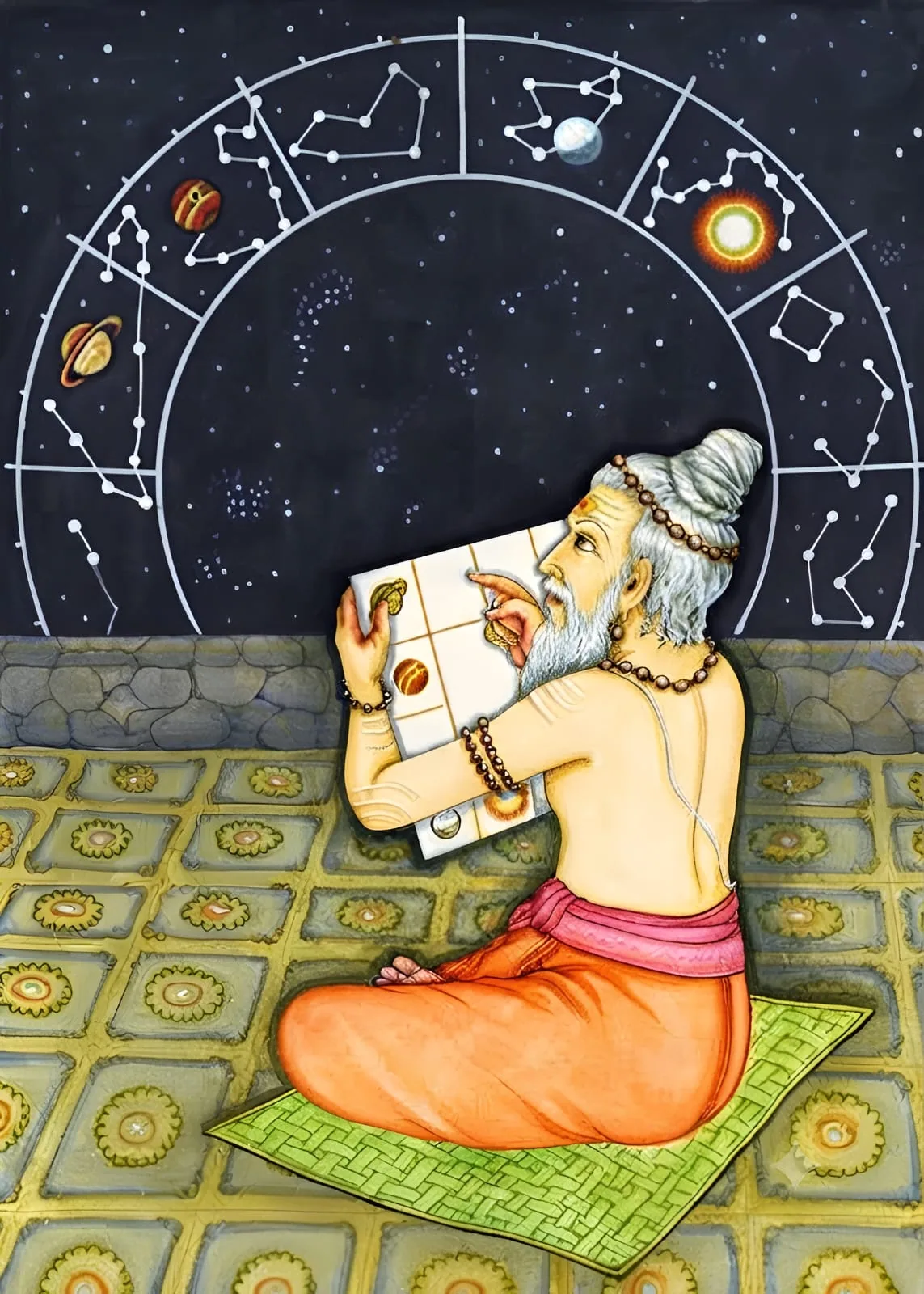
Ancient Vedic sages from the yogic tradition understood the interconnected nature of existence and recognised how life on Earth is influenced by the stars. From this understanding emerged another of yoga’s sister sciences—the ancient system of Vedic astrology known as Jyotish (pronounced “Joe-tish”). The word Jyotish is derived from the Sanskrit word Jyoti, meaning “light.” Jyotish therefore shines a light on our past, our present, and most importantly, our future. Like yoga itself, Vedic astrology aims to help us live healthier, happier, and more fulfilling lives.
There are three principal areas in which Jyotish can be applied. The most common application involves examining the planetary arrangement at the moment of birth. From the distribution of the nine planets among the twelve zodiac signs, a skilled Vedic astrologer can decode and predict our returning karmas—whether favourable or challenging. These predictions cover all the major areas of life, including health, wealth, family, children, status, career, relationships, and spiritual development. In the hands of an experienced astrologer, Jyotish can often provide a karmic perspective on health issues that may otherwise seem difficult to explain.
As well as being predictive, Jyotish is also preventive. Having identified potential difficulties ahead, it can recommend remedies designed to minimise their effects. As one enlightened yogi expressed it, these remedies help “avert the danger that has not yet arisen.” In this way, Jyotish offers the possibility of modifying the impact of returning karmas. Just as the modern world uses software engineering to solve technical problems, the ancient world provided us with what might be called karmic engineering to address life's challenges.
If imbalances in planetary energies are identified within a birth chart, Jyotish offers a variety of techniques to restore harmony. These methods are known as remedial measures or planetary antidotes. One simple example is the use of gemstones that help balance the energy of a specific planet. Emeralds, for instance, are associated with balancing the energies of Mercury. To be effective, the gemstone should touch the skin and is therefore often worn as a pendant or mounted in a specially designed ring.
This approach differs significantly from the concept of birthstones found in Western astrology, as recommendations are based on a detailed analysis of the individual's birth chart. Other balancing methods may include the chanting of mantras or the performance of specific charitable acts. Many people who have applied Jyotish remedies report the removal of significant obstacles and difficulties. While not all karmas can be entirely eliminated, their effects can often be reduced considerably.
There is a well-known saying: “There is a time for every purpose under heaven.” Jyotish astrology helps determine the most favourable time for that purpose, whether it involves marriage, building a new home, making a major investment, launching a business, or undertaking another important venture. By selecting the right time to begin a significant activity, we align ourselves with the supportive forces of nature, encouraging positive growth and successful outcomes. As an enlightened yogi once remarked, “Well begun is half done.”
Jyotish can also assess how well individuals are likely to work together in harmony. This is determined through an analysis of the planetary positions in their birth charts. Traditionally, compatibility analysis has been widely used in India to evaluate marriage partnerships and help ensure harmonious relationships. However, the same principles can also be applied successfully to business partnerships and other forms of collaboration.
It is important to recognise, however, that not every challenge we face is the direct result of returning karma. Some difficulties may arise from our current environment or lifestyle choices. In such cases, the application of other yoga-related Vedic sciences, such as Vastu (the yogic science of harmonious living spaces) and Ayurveda (the yogic system of healthcare), can often help address these issues effectively.
Jyotish comes from a tradition that holds the view that the Creator does not play dice. According to this perspective, we are not born at a specific moment, under a particular arrangement of planets, by mere chance. Rather, the planetary indicators present at birth reflect how karmas from previous lifetimes are likely to unfold in the current incarnation. From this standpoint, we are not controlled by the planets. They simply act as the “cosmic postman,” delivering the karmic packages addressed to us.
Some people prefer not to know what the future may hold. However, the forecasts provided by Vedic astrology can be viewed in much the same way as a weather forecast. If rain is expected, we take an umbrella. Likewise, if Jyotish indicates potential challenges on the horizon, we can proceed with greater awareness and caution while remembering that difficult periods will eventually pass. Like weather forecasting, Jyotish deals with probabilities rather than absolute certainties.
It may seem remarkable that predictions can be made entirely from the planetary arrangement contained within a birth chart—the “planetary code.” Yet we readily accept that a scientist can study the genetic code within a seed and predict how it will develop. The information contained within the seed’s DNA exists in a highly condensed form. Similarly, the planetary arrangement at birth contains encoded information that a Vedic astrologer can interpret to understand the likely unfolding of life events.
Some individuals may find it difficult to accept that certain aspects of life could be predetermined rather than entirely governed by free will. An enlightened Vedic master once explained that life is actually a combination of both. He offered a simple illustration: “Even though our height as an adult is predetermined, the size of our waist is largely a matter of our own free will.”
When comparing Vedic astrology and Western astrology, it becomes clear that each system possesses unique strengths. Western astrology generally places greater emphasis on psychology and the workings of the mind, making a Western birth chart an excellent tool for counselling and self-understanding. Those seeking insight into their emotions, thoughts, and inner psychological patterns may find considerable value in Western astrology.
Vedic astrology, by contrast, focuses more directly on karma and on predicting which karmic influences will manifest during a lifetime and when they are likely to occur. It is unique in offering remedial measures that can significantly reduce the effects of returning negative karmas. In this sense, Vedic astrology is both predictive and preventive, providing practical solutions to many of life’s challenges.
Jyotish also possesses a unique predictive system that identifies the major periods of karmic influence throughout life. This system clearly indicates when the “cosmic postman” is likely to deliver the next chapter of our journey, along with the opportunities, blessings, obstacles, or challenges that may accompany it.
What, then, are the origins of Jyotish?
Like Yoga and Ayurveda, Jyotish belongs to the great family of Vedic sciences that originated through revealed knowledge or cognition within the consciousness of highly evolved sages, seers, and rishis of ancient times. A modern analogy might be that of connecting a computer to a vast remote server and downloading the required information. Of course, the sages required the correct “passwords”—mantras—to gain access to the knowledge stored within the cosmic intelligence.
We know that the sage Patanjali cognised the foundations of yoga as presented in the Yoga Sutras of Patanjali. The science of Jyotish was cognised by another great seer, Maharishi Parashara. To him, the cosmos was an intelligently organised and interconnected whole, where future events could be understood through the arrangement of the stars.
Jyotish has certainly stood the test of time. For more than five thousand years, people have derived guidance and benefits from this ancient science.
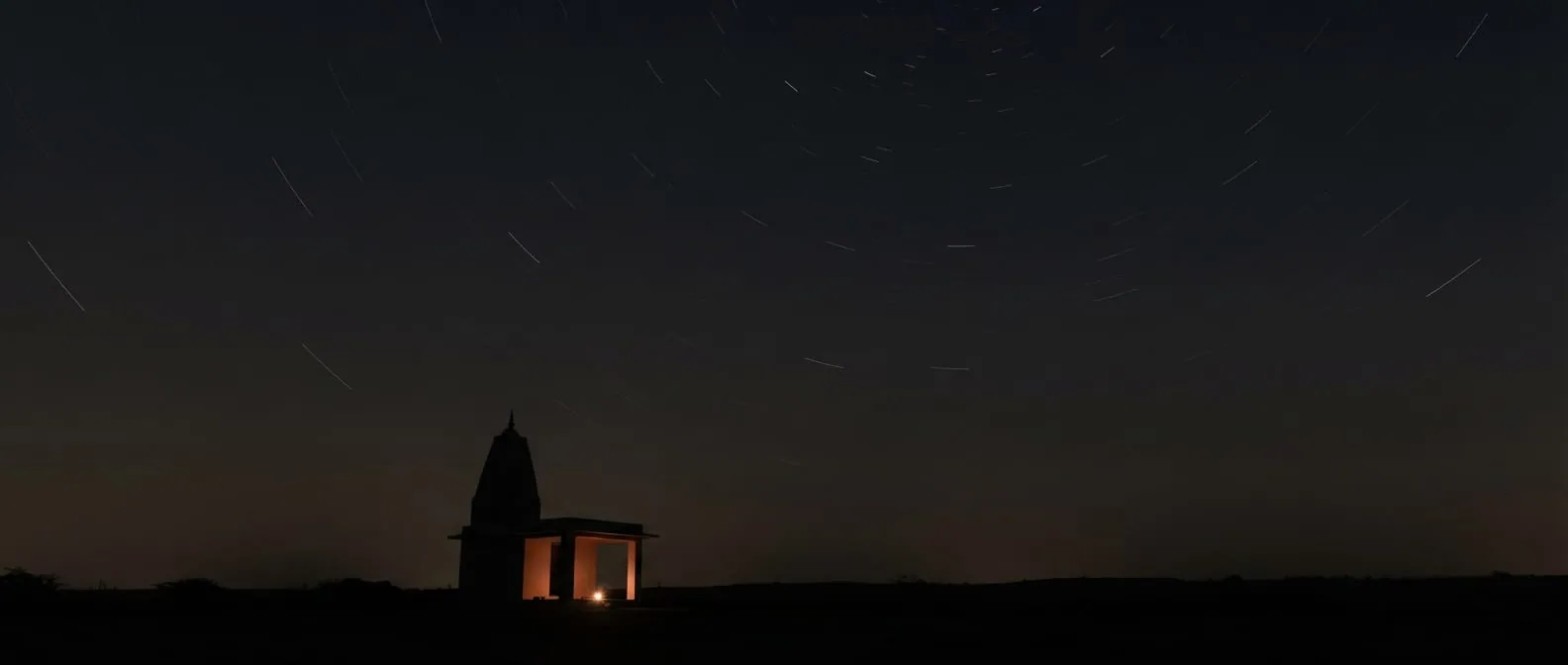
The next time we practise yoga outdoors on a warm summer evening, it is worth pausing to look up at the stars. Not only are they beautiful in their own right, but they also symbolise the profound relationship between ourselves, our returning karmas, and the cosmos itself. Jyotish astrology makes practical use of this relationship. Through its predictive and preventive methods, this ancient wisdom offers genuine benefits. By reducing karmic burdens and helping remove obstacles to progress, Jyotish can support us in leading healthier, happier, and more fulfilling lives.
← Introduction